

What is Antifragility? What are antifragile teams?
Antifragility is the ability of a system to thrive and improve by using external stress factors, shocks and uncertainty.
The concept of antifragility has been detailed by Nassim Nicholas Taleb in his book “Antifragile: Things That Gain From Disorder”. Building on his research and findings on antifragility in various systems, we developed an antifragility approach for team performance.
In prolonged contact with stress factors:
Fragile teams break
Robust teams resist and stay the same
and antifragile teams develop by using them to become stronger
How Do We Do It?
01
Team Antifragility Dianostic
02
Team Antifragility Workshop
03
Team Antifragility Roadmap

Step 1
Team Antifragility Diagnostic
Drawing on our extensive experience working with teams and applying the foundational principles of antifragility, we have developed a proprietary diagnostic tool specifically designed for teams.
By completing the Team Antifragility Diagnostic questionnaire, you get an assessment of your team’s Antifragility Score and its key dimensions. Additionally, we analyze the driving factors behind the score, providing valuable insights into the areas your team could prioritize to enhance its antifragility.


Step 2
Team Antifragility Workshop
Drawing on our extensive experience working with teams and applying the foundational principles of antifragility, we have developed a proprietary diagnostic tool specifically designed for teams.
By completing the Team Antifragility Diagnostic questionnaire, you get an assessment of your team’s Antifragility Score and its key dimensions. Additionally, we analyze the driving factors behind the score, providing valuable insights into the areas your team could prioritize to enhance its antifragility.
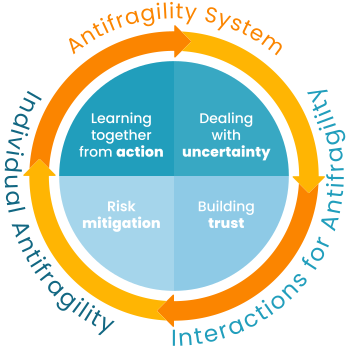
1.Learning together from action
For companies to achieve agility and adaptability, teams must learn and grow together based on their real experiences. Learning as a collective unit differs significantly from individual learning; it requires intentional design rather than mere random learning occasions. This entails implementing distinct processes, fostering a structured feedback culture, adopting a systematic approach to experimentation, and cultivating a constructive attitude toward mistakes
2.Dealing with uncertainty
In a world filled with uncertainty, teams need to embrace and navigate these conditions with wisdom. This requires deliberate training to develop new skills and capabilities that enable teams to make decisions and learn from them in uncertain situations. A crucial prerequisite is granting teams the autonomy to solve problems independently. However, effective problem-solving can only occur when teams possess the ability to handle conflicts constructively. Tensions within a team can serve as catalysts for progress, and teams need to learn how to harness these tensions to their advantage.
3.Building trust
Trust is a fundamental requirement for any team’s performance. However, to truly become antifragile, a team must cultivate a higher level of trust. This form of trust encourages individuals to openly express their concerns and admit their mistakes, while also fostering a commitment to always communicate the truth to one another, even when it may be uncomfortable or difficult to hear.
4.Risk mitigation
It is essential to only take risks that you can afford to lose. In order for a team to become antifragile, it must establish effective processes for consistently evaluating risks and opportunities, aligning them with available resources, and developing contingency plans for high-risk scenarios.
Step 3
Team Antifragility Roadmap
Building upon the discussions held during the workshop, the team crafts a roadmap for future development. The team initiates the implementation of this plan, and after six months, another assessment of its antifragility can be conducted.
During this period, we can have regular check-ins with the team, to measure progress, identify obstacles, and make any necessary adjustments to ensure continued growth.

